




.png?width=515&name=Alison%20Kynoch%20Mediator%20Spotlight%20Blog%20Header%20(1).png)

Table of Contents
In this Spotlight series, we interview CEDR-Accredited Mediators from around the world and from different professional backgrounds and industries. The aim is to understand what motivated them to train as a mediator, what skills and capabilities they developed, how they are using these in their professional and personal life and wider reflections and opportunities for their field.
This Spotlight is with Alison Kynoch, Head of Employee Relations, APAC & MEA at Deutsche Bank based in Singapore. Prior to Deutsche Bank, Alison was Global Head of Employee Relations at DLA Piper, Employee Relations Director at Credit Suisse and Inhouse Legal at BNP Paribas.
Alison achieved her CEDR Accreditation in 2026.
Why Did You Decide To Become A CEDR-Accredited Mediator?
Over many years practising in an Employee/Labour Relations career, I have seen conflict escalate quickly, dramatically and often unnecessarily, inflicting damage and harm in unpredictable ways, frequently unforeseen. My role now demands much more than “handling cases” and instead, it is much more about building a culture where issues are resolved earlier, more humanely and with better outcomes.
In Banking, conflict is common because the environment is high‑stakes, heavily regulated, and deadline-driven. Therefore, a small breakdown in communication can prove destructive and escalate quickly into a formal grievance with the potential to result in protracted and costly litigation. It’s a lose-lose situation and the process leaves all parties drained, ensuring that no side emerges victorious.
Becoming a CEDR‑Accredited Mediator felt like the right next step for me – to build a skillset that would help me intervene earlier and more effectively—before positions harden, relationships deteriorate, and risk starts to climb.
Why Did You Choose CEDR?
CEDR was recommended to me by a mentor who I deeply respect. I have had the benefit of seeing her neutralise many highly, charged and difficult workplace conflicts, moving the parties toward sustainable and realistic agreements and outcomes.
She was very honest with me and not wrong when she shared that the route to CEDR accreditation would be intense, however she always described CEDR as delivering the best training she had ever taken.
CEDR stands out for three reasons: credibility, intensity, and practicality.
The accreditation is widely recognised as a benchmark in mediation. That matters to me in a regulated industry like Banking, where stakeholders want assurance that a process is robust, defensible, and delivered to a high standard.
The programme is deliberately intensive and rigorous, providing professional skills’ training with many hours of expert-led learning and a formal assessment process. I was looking for something that would stretch me, not just “introduce” mediation concepts.
The competencies developed go beyond formal mediation and they map directly to what I do in my role; active listening, managing emotion, reality testing, reframing, and guiding difficult conversations towards resolution.
Finally, the scale of the alumni network appealed to me, it signals a global community of practitioners and a shared standard of practice that I can keep learning from long after the course.
What Challenged You The Most During The Training?
What pushed me wasn’t the structure of the mediation, it was the discipline of maintaining patience and remaining highly curious, under pressure.
In my professional role, it’s easy to feel you need to diagnose quickly and hurtle toward solutions. The training reinforced the opposite: if you slow down and help people feel heard, you get to the crux of a conflict and what really matters to the parties.
As a result you get stronger commitment, durable agreements and resolution which can realistically be sustained.
At the start of each day, I now regularly remind myself that, “you need to slow down to speed up”. This does not just help me in my professional life, pausing, reflecting and doing things carefully at the start of an activity or goal, can help me to move faster and more effectively.
Additionally, my experience taught me three practical lessons I now rely on:
-
Hold the process — especially when emotion rises; structure creates safety.
-
Listen for interests, not positions — what someone says they want is rarely the whole story.
-
Use questions as a tool — the right question can shift a stuck conversation faster and give you the clarity you really need.
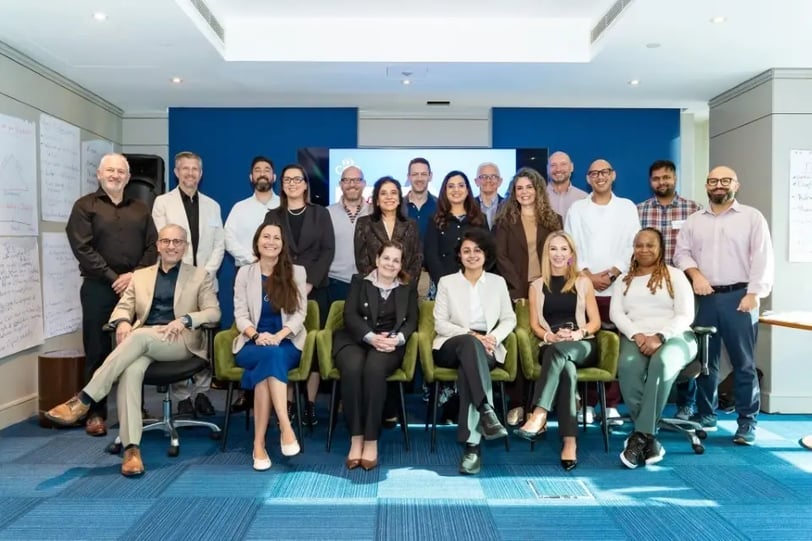
Alison (front row, second from the right) trained to become a CEDR-Accredited Mediator in Dubai, 2026.
What Has Stayed With You Most From The Training?
The biggest shift is that I now see conflict less like a “problem to fix” and more like a structured conversation to facilitate in order to enable people to regain clarity, dignity, agency and choice.
The specific skills taught on the course to achieve this include:
-
Active listening with purpose, to move conversations from accusation to impact and needs.
- Managing emotion, not avoiding it — acknowledging what’s happening in the room and recognising its impact.
- Reframing and neutral language
- Reality testing — helping parties think through options, consequences, and what “good” looks like, without telling them what to do.
How Are You Using The Skills Of A Mediator In Your Day-To-Day Life?
I use the CEDR toolkit daily, often without calling it “mediation.” Practically, it shows up in early intervention, coaching and in high risk and complex cases.
Going forward, I’d like to embed mediation capability more broadly, building a shared language for conflict across leaders and HR, and creating clear pathways for when mediation is the right option, versus when a formal route is required.
Looking At Your Organisation And Industry, Where Do You See The Greatest Opportunity For Mediation?
In Banking, there is significant opportunity to be derived from early, confidential resolution, in situations where relationships and performance are key and before issues become formal, entrenched, and expensive in time and trust. Beyond banking, the need is universal anywhere people work under pressure.
Mediation provides a disciplined way to restore communication and move forward, without automatically defaulting to adversarial processes.
What Would You Say To Someone In A Similar Role Who Is Considering This Training?
I’d say: if you’re in any people-facing leadership role and you want to sharpen your skills in handling high emotional responses, influencing outcomes, creating durable agreements and identifying the real issues faster and focusing on interests and not just positions, then it is right for you.
I will be honest: it’s intensive and you get out what you put in. The preparation, the practice, and the feedback are what make it transformative.
If you want a course that is practical, challenging, and immediately applicable to your day job, it’s absolutely worth it.
Final Reflections on Mediation More Broadly?
For me, CEDR training strengthened two things at once: humanity (how we treat people in difficult moments) and business effectiveness (how quickly and sustainably we resolve issues). In any context, that combination is powerful because the goal isn’t just to close a case, it’s to restore trust, reset expectations, and keep teams functioning.
More broadly, mediator skills make you a better partner to the business. You become the person who can walk into a tense room, create structure and psychological safety, and help people do the hard work of finding a way forward.
That’s the kind of capability every organisation needs, now more than ever.
Related Posts
Not just thought leadership, actionable insight.


