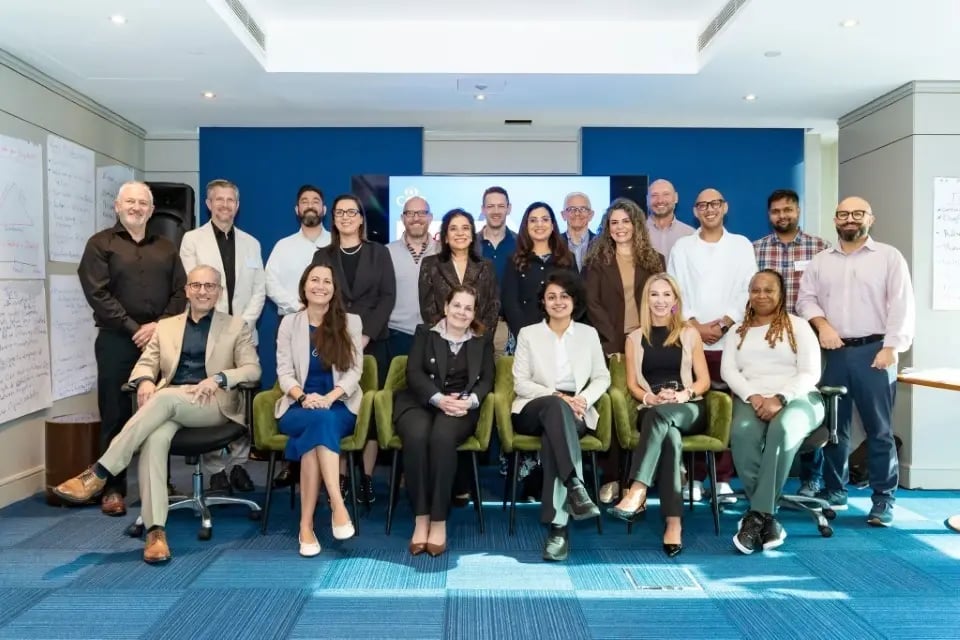
In this Spotlight series, we interview CEDR-Accredited Mediators from around the world and from different professional backgrounds and industries. The aim is to understand what motivated them to train as a mediator, what skills and capabilities they developed, how they are using these in their professional and personal life and wider reflections and opportunities for their field.
This Spotlight is with Debbie Sanders. Debbie began her career in a trade union and has led HR, ER and Engagement and Communications teams in large, unionised organisations including NATS, GSK and EDF Energy as well as working in various capacities for ACAS, British Airways, Virgin Atlantic, Gatwick Airport, M&S and Network Rail. She is currently a Consultant and Founder at Make Work Better which is an innovative collective employment relations consultancy helping organisations to introduce sustainable and effective ways of working with their unions, employee representatives and employees.
Debbie achieved her CEDR Accreditation in 2026.
Why Did You Decide To Become A CEDR-Accredited Mediator?
I first trained as a workplace mediator with CEDR in 2004 when I was a self-employed consultant. Much of my work at the time was with unions and employers who were wishing to rebuild relationships post-conflict. The course really helped me to think clearly about how I could approach these projects – using the structure of mediation and by developing key skills. I can often deal with 12 people in a session so I took a lot from the course and developed an approach which has worked well over the years.
After the CEDR course, I continued to research and learn about group conflict methods and techniques as part of a post-graduate certificate in the Psychology of Organisation Development and Change.
I have had some challenging projects and in-house roles with unions and employers and the mediation skills have been so valuable in dealing with individual and collective conflict. I helped two unionised organisations set up in-house mediation schemes with union reps and managers trained as conflict facilitators. I have seen the benefits of reduced grievances, earlier resolution of conflict, better conversations, reduced cost and stress.
As my work in this area continues to grow, it seemed a good time to reinvest in my skills for this type of work, learn from others, practice and fine-tune some skills. The first CEDR course left such a strong impression on me that I decided to get back in touch with CEDR. After conversations with them, I made the decision to aim for accreditation.
Why Did You Choose CEDR?
Last year I collaborated with some CEDR colleagues on a network event (I run a network of industrial relations senior leaders). Working with them reminded me what a strong, professional team they are - they are very good at what they do. I wanted to be challenged, go deeper into the process and skills, and not just reiterate what I had already learnt and was practicing. The course needed to push me and I felt I would find this level of challenge with the CEDR international accreditation programme.
What Challenged You The Most During The Training?
I knew when the pre-reading arrived that this was going to be intense! The videos, pre-course work and reading were very thought-provoking, methodical and analytical. When the course started, we were role playing for much of the time and had the opportunity to practice being the mediator and also one of the parties, in separate and joint meetings.
The preparation for these practice sessions was the same whether you were the mediator or a party – you didn't want to let down your colleagues by not preparing. So, the intensity of the practice sessions was tough. Also, as the mediator, you received real-time feedback – the role play stopped, you received feedback, it started again. You also received coaching afterwards – all extremely valuable and constructive from some very experienced mediators.
No-one really enjoys role playing but this was the best, but most intense way to practice. I definitely learnt that I could relax more! I also didn't need to understand all the details, be prepared but don't over prepare and it was not my job to solve the conflict, it's my job to help them reach an agreement.
What Has Stayed With You Most From The Training?
I found the active listening tool kit extremely valuable and a great reminder of the range of tools we can use during all stages of the mediation process. They are powerful and effective techniques which help the parties to build trust, relax, explore and negotiate.
The other key points I have been considering are what to look for to indicate when the parties are ready for joint meetings, how to deal with emotion and also, to be flexible in your approach. This is a route map, not a linear process. Remember to be organised, relaxed but also flexible.
How Are You Using The Skills Of A Mediator In Your Day-To-Day Life?
The active listening skills are the most underrated but powerful skills we can all develop. I know how different I feel when I believe I am being listened to. So, I am trying to build them into my work (and personal life) more.
At a recent joint session of union representatives and managers, I made some notes to remind myself of some skills such as paraphrasing, reframing, summarising and hypothetical questions.
I also wrote down "Tell me more, Explain to me, Describe to me" to remind me to ask questions and explore more without sounding like I am interrogating the party.
The exploration phase of the mediation encourages the use of active listening to open up the interests and needs of the parties. I have reflected that in some joint union-employer sessions, this phase of a mediation is one where I may need to spend more time to really uncover issues and help the parties move on. Some of the issues I am trying to uncover may have lasted for many years (sometimes decades) so spending more time here is critical.
Looking At Your Organisation And Industry, Where Do You See The Greatest Opportunity For Mediation?
It feels like the world is more polarised today and this is manifest in the workplace. Investing in managers as mediators or facilitators of conflict in their teams, with their unions and employee representatives seems more critical than ever. The cost of conflict in the workplace is huge and growing – not just the financial costs but the costs to the individual in terms of stress, health and well-being. I would love to see more organisations developing these skills in managers and not just using mediation when things have gone wrong.
I think there will always be a need to use the mediator tool-kit in the workplace – team leaders, managers, senior leaders, union reps, employee reps – they all need active listening skills, to understand how to best manage emotion, create safe workplace, understand positions, interests and needs and build agreements.
What Would You Say To Someone In A Similar Role Who Is Considering This Training?
For someone in employee relations, industrial relations and HR roles, mediation is a very valuable skill to develop. You don't need to become a mediator but you will find the skills hugely transferable and it will open your eyes and help you understand some complex situations around you and why people get stuck in positions.
I would definitely look at the CEDR courses and decide what is best for you.
Final Reflections on Mediation More Broadly?
I often say to people that the mediation skills training I have done has been hugely beneficial to me as a self-employed consultant, as an in-house ER/IR/HR leader and to me as a person. When you are self-employed, this is a big investment in time and money, but I feel I got so much out of it, it was worth every penny!