




The £51 Billion Challenge: The Case for Early Conflict Resolution


Table of Contents
A Number Businesses Can No Longer Ignore
Workplace conflict now costs UK employers an estimated £51.2 billion a year. That is the headline finding of new research published by Acas on 24 November 2026, and it should give every Chief People Officer, HR Director and executive team pause for thought.
To put it into context, when Acas last ran this analysis in 2021, the figure stood at £28.5 billion. Even after adjusting for inflation, the cost has risen by around 40% in real terms. It now equates to roughly 1.7% of UK GDP, or £1,690 for every employee in the country.
Yet the most important message in the report is not the size of the number. It is from where that number originates.
As the research makes clear, the cost of conflict is driven far less by how often it happens than by how far organisations allow it to escalate. Resolving problems early and informally is the most economical route by some distance. Costs then mount sharply as conflict affects health and productivity, moves into formal procedures and, ultimately, leads to people leaving.
At CEDR, this is something we see play out every week, both in the workplace disputes we mediate and in the organisations we train and advise on conflict. In this article, we look at what the Acas research tells us, why the problem is becoming more urgent, where the typical organisational response falls short, and what a better approach looks like.
How Much Does Workplace Conflict Cost UK Employers?
Acas estimates that workplace conflict costs UK employers £51.2 billion a year, or £3,658 for every individual directly involved in a conflict. The analysis draws on a nationally representative survey of 4,556 working people carried out in 2025, alongside new CIPD data on the time organisations actually spend managing disputes.
Compared with Acas's first estimate in 2021 (£28.5 billion), the new figure is 80% higher, or around 40% higher once inflation is taken into account. Over the same period, the number of people leaving their jobs because of conflict has risen from around 900,000 to 1.6 million, although Acas cautions that refined methods mean the two studies are not directly comparable in every respect.
Three findings stand out.
1. Conflict is more widespread than ever. 46% of UK employees experienced conflict at work in the previous 12 months, up from 35% in 2019. That is around 14 million people. Capability and performance issues were the most common source of conflict, and people most often named their own line manager or a colleague as the other party.
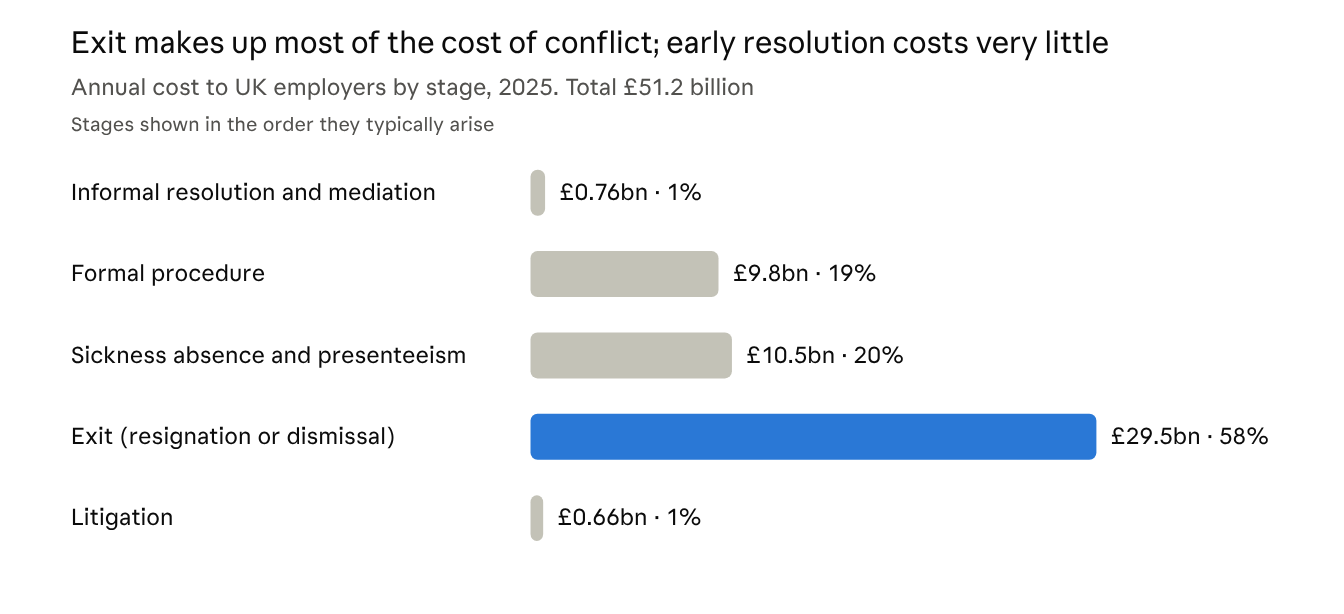
2. The cost sits at the wrong end of the curve. Informal resolution, including conversations, facilitated conversations and mediation, accounts for just 1.5% of the total. Formal grievance and disciplinary procedures cost £9.8 billion. Sickness absence and presenteeism cost £10.5 billion. And by far the largest component, £29.5 billion or 58% of the total, comes from people leaving their jobs. An estimated 1.6 million employees left an organisation as a direct result of conflict last year.
3. A small number of cases drive most of the cost. The most expensive 10% of conflicts account for 62% of the total, and these almost always end with someone leaving. Conflicts involving bullying, discrimination or harassment cost around two and a half times as much as other conflicts. Conflicts between an employee and their own line manager cost around twice as much as those between colleagues, because almost one in four ends in exit.
Behind the economics sits a human cost that is easy to miss. 57% of people experiencing conflict reported stress, anxiety or depression as a result. Yet only one in ten took time off. Most simply carried on, quietly less motivated and less productive.
Why is Workplace Conflict Becoming More Urgent?
The Acas figures reflect a working world that has changed profoundly since 2019. Several forces are now converging, and together they make early resolution a strategic priority rather than a nice to have.
A shifting legal landscape. The Employment Rights Act 2025 is being phased in through 2026 and 2027. From January 2027, the qualifying period for unfair dismissal claims falls to six months. Since October 2026, independent trade unions have been able to request access to workplaces, including where they are not recognised. Meanwhile, the draft revised Acas Code of Practice on disciplinary and grievance procedures places new emphasis on informal resolution, facilitated conversations and mediation. Employers will increasingly need to show that they genuinely considered early resolution before reaching for formal process.
AI is changing how grievances are raised. Generative AI has made it far easier for employees to frame concerns as formal, legally structured grievances and claims. Acas notes that this is already contributing to more complex and expansive litigation. A frustration that might once have been raised over a coffee can now arrive as a ten-page document citing case law.
Disengagement is deep and persistent. Employee engagement in the UK sits at just 10% (Gallup, 2026), among the lowest in Europe. Job satisfaction is at its lowest recorded level. Return to office mandates, restructuring, hybrid working and relentless performance pressure all provide fertile ground for conflict.
Economic and AI anxiety is running high. PwC's 2026 UK Hopes and Fears survey found that 44% of workers see economic volatility as the biggest threat to their job security over the next three years, while 37% point to AI taking on more of their tasks. Six in ten say cost-of-living pressures affect their work. Separately, research from King's College London found that seven in ten workers are worried about the economic impact of AI-driven job losses. Anxiety of this kind rarely stays private. It tends to surface as resistance to change, tension during restructures and grievances about how decisions are made.
Employee activism is now part of working life. As CEDR explored in its white paper, Employee Activism: Navigating Conflict for Positive Change, employees increasingly expect a voice on what their organisation stands for and how it makes decisions, from social and ethical issues to how new technology is introduced. Polarisation outside work spills into the workplace. Yet many organisations have responded by tightening policies and restrictions rather than building their capability for dialogue, which risks pushing disagreement underground rather than resolving it.
Certain groups are disproportionately affected. Under-35s make up 36% of the workforce but account for 46% of the cost of conflict, because their conflicts more often end in them leaving. Employees with a long-standing health condition make up a quarter of the workforce but account for 45% of the cost.
Indeed, Acas describes an employment landscape that is ripe for conflict at a time when many organisations and managers lack the capability to address it. That is the gap organisations now need to close.
How Do Most Organisations Handle Workplace Conflict, And Why Is It Falling Short?
Most organisations do not set out to manage conflict badly. But the typical response tends to fall into one or more of four patterns, and the Acas research shows clearly why each of them is costly.
1. Doing nothing and hoping it goes away. One in three conflicts involves no conversation of any kind. In most of these cases, people simply let the issue go. Yet these conflicts are less likely to be resolved and have almost twice the odds of ending with someone leaving. Avoidance is a decision, and can be an expensive one.
2. Defaulting to formal process. Conflicts that reach a formal grievance or disciplinary procedure make up 13% of cases but 40% of the total cost. The average grievance now absorbs 23.5 days of staff time across managers, HR, legal advisers and representatives. Formal procedures have an important role in serious cases. However, their use is not clearly associated with better resolution, and they often harden positions and damage relationships beyond repair.
3. Focusing on legal risk instead of relationships. Litigation costs UK employers an estimated £665 million a year. Conflict-related exits cost £29.5 billion. An approach built around minimising tribunal risk is therefore aimed at a very small part of the problem, while the far larger cost goes under the radar.
4. Under-investing in the people who handle conflict day to day. Managers are best placed to spot problems early, yet many lack the confidence and skills to act. Where they are trained, it is often a single e-learning module or a short session that feels safe, theoretical and easily forgotten. Interestingly, the Acas data shows just how much good skills matter. Where an employee raised a conflict directly with the manager they were in conflict with, only 13% went on to leave. Where they did not, the figure was 33%.
What we hear from organisations
Our observation, drawn from our conversations with HR, ER and business leaders across sectors, is that the same challenges come up again and again:
- Managers put off difficult conversations, allowing tensions to build for months.
- Technical specialists are promoted into people management roles without the skills to handle conflict.
- HR teams are pulled into issues late, and are not always confident about which intervention to use.
- Internal mediation exists on paper but is seen by employees as a box-ticking exercise.
- Senior HR and legal teams typically only become involved once an issue is contentious, by which point managers may have been dealing with it for up to two years.
CEDR's own market research with HR, legal and customer service professionals (2023) found that respondents believed 50% to 90% of the issues they dealt with could have been resolved earlier if handled differently.
What Is The Best Way To Manage Workplace Conflict?
The Acas conclusion is clear. Early resolution needs to be part of how an organisation works, not just how individual managers behave. At CEDR, we could not agree more, and it reflects how we have worked with organisations for more than 35 years.
In our experience, there are three things that separate organisations that manage conflict well from those that do not.
1. Building Capability Along The Whole Conflict Escalation Curve
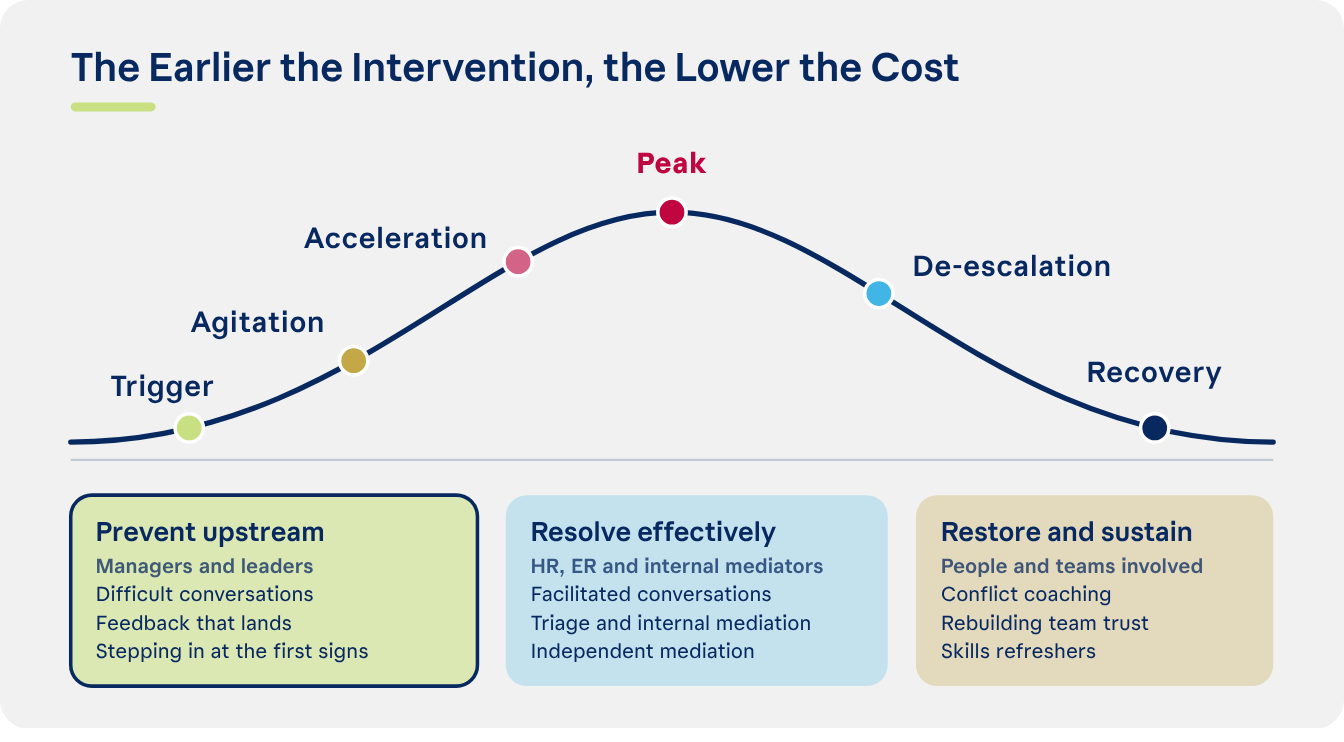
Conflict is not a moment in time. It moves along a curve, from early friction and difficult conversations, through active disputes, to formal processes, exits and claims. Organisations need the right capability at each stage, but the greatest value lies at the start.
- Prevent upstream. Equip managers and leaders to hold effective and early difficult conversations, give feedback that lands, stay composed in tense situations and step in at the first warning signs. Confidence building, as much as capability is important at this stage, particularly as most managers are never sufficiently trained in these skills, let alone how to use them in real-life, uncomfortable situations.
- Resolve effectively. Give HR and ER teams the skills to run facilitated conversations, triage cases and choose the right intervention. Build internal mediation capability, from awareness through to accreditation, and bring in independent mediators when a dispute is entrenched or a legal claim is in view.
- Restore and sustain. Use conflict coaching, team sessions and supported return to work conversations to rebuild trust after a dispute, so the same conflict does not return.
Importantly, the Acas research reminds us that two-thirds of conflicts do not involve the employee's own manager. Capability therefore cannot sit with managers alone. In CEDR's work, HR business partners, for example, are increasingly being equipped not only to resolve conflict themselves but to coach the managers they support through it.
2. Aligning People, Policy and Process
Training is powerful. However, on its own it is only one part of a wider approach we recommend to clients. Skills only make a lasting difference when they sit within a system that expects, enables and rewards early resolution. We think about that system in three parts.
- People. The right skills for the right people at the right level. Senior leaders, line managers, HR business partners, ER specialists and internal mediators all play different roles, and each needs something different, albeit with a common foundational ability and skillset.
- Policy. A clear framework and guidance that make early engagement the expected first step, not an optional extra. That means grievance, disciplinary and dignity at work policies that actively signpost informal resolution and mediation, rather than defaulting to formal routes for example.
- Process. A defined set of interventions, from a manager conversation to a facilitated conversation, internal or external mediation, investigation or formal procedure, with clear guidance on which fits which situation and how they connect. With this, formal procedures become the backstop, not the starting point. Additionally, good data on conflict trends helps target interventions where they can make the best impact.
Notably, this mirrors the integrated approach Acas itself recommends: conflict competence at every level, procedures that are integrated with mediation and other forms of dispute resolution, and robust data to guide strategy.
3. Training That Is Challenging, Realistic And Practitioner-Led
Most people we train know, in theory, what a good difficult conversation should look like. In fact, the majority of the time we work with professionals who inherently have good instincts and motivations. The problem is that the ability to apply knowledge and skills under pressure and in sticky situations, particularly when dealing with colleagues who are distressed, defensive or angry.
That is why we believe training must be experiential, role-play based and at times uncomfortable and emotionally and challenging. It should be built from realistic, anonymised scenarios drawn from inside the organisation, identified through a proper training and learning needs analysis. And it should involve plenty of practice, with live coaching, individual as well as group feedback, supported through a high trainer-to-participant ratio.
Crucially, it should also be led by people who actually do this for a living. CEDR's trainers are all practising workplace and employment mediators who resolve escalated disputes every week, alongside former hostage and crisis negotiators who know what it takes to stay calm and influential under extreme pressure. Participants gain stress-tested skills, not theoretical perspectives. It is one reason our Mediator Skills Training holds a Net Promoter Score of 89.
What Does Early Conflict Resolution Look Like In Practice?
The organisations making the most progress are those treating conflict capability as a long-term investment. A few recent examples from CEDR's work illustrate the point.
Creating a trusted route to early resolution at Sanofi. Sanofi wanted to give employees a confidential, independent place to raise concerns early, reducing costly and time-consuming investigations and stopping problems from escalating. CEDR partnered with Sanofi to build its internal Ombuds Office, from aligning stakeholders and developing a competency framework, to role-play based recruitment and an Ombuds Office Charter setting out how the service works. The 21-strong Ombuds team then completed three days of intensive skills training with CEDR, including individual coaching and formal assessment against the framework. Since launch, the team has continued to develop through regular reviews of real cases and coaching on complex situations, so its Ombuds can explore concerns in depth rather than simply triage them. Read the full Sanofi story.
Moving HR earlier in the process. A global pharmaceutical company wanted its HR Solutions and HR Business Partner teams to intervene before issues escalated into investigations or litigation. CEDR designed a two-day, role-play intensive programme focused on facilitated conversations and triage, so HR professionals could judge which intervention each situation needed and support senior leaders to model open dialogue.
Building capability from the top down. Following a needs analysis, a global consumer goods group put its most senior HR and HR Legal professionals through three-day workplace mediator skills training. This was the first step in upskilling its wider HR population to manage conflict proactively, alongside work on how mediation could sit within its existing speak-up and ethics processes.
Leadership that models the change. One organisation accredited six of its most senior HR and ER leaders, including its Chief People Officer, as CEDR Accredited Mediators as part of a wider transformation in how workplace conflict is managed.
Creating a trusted internal route. Another organisation certified twelve employees as internal workplace mediators through an intensive four-day programme, giving colleagues a resolution route that avoids costly and lengthy formal processes.
Restoring the team afterwards. Following a mediation linked to a discrimination claim, three CEDR conflict coaches worked with an employee and two managers over four months to rebuild trust and successfully reintegrate the team.
Where Should Organisations Start?
For HR and business leaders reflecting on the Acas findings, the best starting point is an honest assessment of how conflict is handled today, both across the organisation and within individual teams. The questions below draw in part on CEDR's guidance on collaborative working, which has long made the case that to do good collaboration, you have to do good conflict.
Across the organisation, ask yourself:
- Do we know what conflict is costing us? Do we track grievances, conflict-related exits, sickness absence and time spent on formal cases, and can we see where they cluster?
- Is there a credible informal route before formal process? Do our policies actively point people towards early conversations, facilitated conversations and mediation?
- Do HR and ER know which intervention to use, and when? Is there a shared approach to triage, and are internal mediators trusted and used?
- Do we have mediation capability at leadership level, not just within HR?
- What happens after a dispute ends? Is anyone supporting the people and teams involved to rebuild trust and performance?
Within your teams, do you and your colleagues:
- Address conflicts promptly and directly with each other, rather than letting them drift?
- Keep disagreements factual and descriptive, acting on information rather than assumptions?
- Keep the tone non-threatening and non-judgemental, and listen fully to those who disagree?
- Discuss personal issues affecting performance openly, and recognise the effect of emotions on working relationships?
- Respond constructively to feedback that calls for a change in performance or behaviour?
- Show flexibility with different communication styles, including across cultures?
- Feel comfortable reaching out to an independent facilitator or mediator when you cannot resolve something yourselves?
If the honest answer to several of these is "not really", that is where the cost of conflict is most likely building up, and where the earliest and lowest-cost gains can be made.
Turning The Cost of Conflict Into An Opportunity
At more than £50 billion a year, the cost of workplace conflict is simply too large to treat as a niche HR concern. And the economics of early resolution are stark. A conversation with a manager costs an employer around £71. A formal procedure costs around £5,000. Losing an employee to conflict costs more than £18,000.
The good news is that most of this cost arises after early opportunities to resolve problems have been missed. That means it is, to a large degree, within an organisation's control.
Organisations that invest now in the skills, frameworks and interventions that make early resolution the norm will not only reduce cost. They will also retain talent, protect wellbeing and build the kind of trust that makes difficult change easier to deliver.
If you would like to explore how CEDR can help your organisation build conflict capability, from bespoke training for managers and HR teams to workplace mediation and conflict aftercare, please get in touch.
Sources
- Acas (2026), Estimating the costs of workplace conflict to UK employers. Also the source for the cited Gallup (2026), CIPD (2026), Employment Rights Act 2025 and draft Code of Practice references.
- PwC (2026), UK Hopes and Fears Survey: Workers more worried about economy than AI.
- King's College London (2026), Public have more fear than hope on AI and future of work.
- CEDR (2024), Employee Activism: Navigating Conflict for Positive Change.
- CEDR (2025), The Eleventh Mediation Audit.
- CEDR (2023), Research findings: personas, research conducted by Purplefully.
Related Posts
Not just thought leadership, actionable insight.

